

The New Robinhood Platinum Credit Card: Can It Compete With the Amex Platinum?
Robinhood has spent the past decade building its reputation as a disruptive brokerage platform. Now the company is pushing into premium finance with the launch of a high-end credit card aimed at affluent customers.
The Robinhood Platinum Credit Card, announced in March 2026, carries a $695 annual fee and is positioned directly against legacy premium cards such as the American Express Platinum Card and the Chase Sapphire Reserve.
At first glance, Robinhood’s move might seem surprising. But the strategy makes sense: the company’s user base has matured, and many customers who began as young investors now have higher incomes and more complex financial needs.
The real question is whether this new entrant offers enough value to compete with the established giants of the premium credit card market.
Overview of the Robinhood Platinum Credit Card
The Robinhood Platinum card is designed to sit at the very top of the company’s ecosystem. It builds on the popularity of the Robinhood Gold card but targets users willing to pay for premium travel and lifestyle perks.
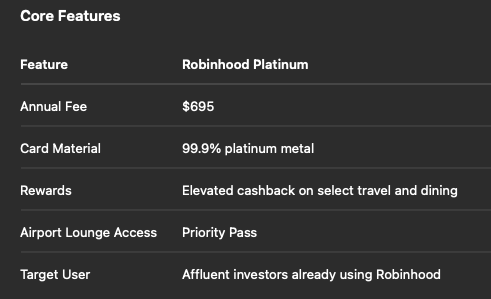
Robinhood has stated that the perks package could deliver up to roughly $3,000 in potential annual value, placing it in the same range as other premium cards.
Some of the headline benefits include:
5% cashback on dining and flights
Up to 10% cashback on hotels
Priority Pass airport lounge access
Credits for travel services and ride experiences
Integration with the Robinhood financial ecosystem
The company has also leaned heavily into the physical prestige of the card itself, with the premium version reportedly made from nearly pure platinum metal.
While the luxury presentation certainly attracts attention, the real question for cardholders is how the benefits stack up against existing premium cards.
How the Robinhood Platinum Compares to the Amex Platinum
To understand the positioning of the Robinhood Platinum card, it helps to compare it directly with one of the most recognizable premium cards on the market: the American Express Platinum Card.

The Robinhood card is slightly cheaper, but the value proposition is different.
Where Robinhood May Have an Edge
1. Simple Cashback Rewards
One of Robinhood’s biggest advantages is simplicity.
Instead of navigating airline transfer partners or complicated redemption strategies, the Robinhood Platinum card emphasizes straightforward cashback rewards on travel and dining purchases.
For users who prefer simplicity over optimization, this model can be appealing. Many premium credit cards require knowledge of airline alliances and hotel programs to extract maximum value.
Robinhood’s approach removes that complexity.
2. Deep Integration With Investing
Another unique element is the card’s connection to Robinhood’s broader financial ecosystem.
Cashback rewards can be directed toward:
Brokerage balances
Investment portfolios
Other financial services inside the app
This creates a feedback loop where everyday spending can effectively contribute to long-term investing.
For Robinhood users already managing their investments on the platform, this integration could be a meaningful advantage.
Where the Amex Platinum Still Wins
Despite Robinhood’s ambitious offering, the Amex Platinum card still dominates in several key areas.
1. Lounge Access
Airport lounge access is one of the most valuable perks of premium travel cards.
The Amex Platinum includes:
Centurion Lounge access
Priority Pass lounges
Delta Sky Club access when flying Delta
Plaza Premium lounges
Robinhood’s offering appears to rely primarily on Priority Pass, which is widely available but has become crowded in recent years.
For frequent travelers, this difference alone can justify choosing Amex.
2. Transferable Points
The Amex Platinum earns Membership Rewards points, which can be transferred to a wide range of airline and hotel partners.
This unlocks outsized value for experienced travelers. For example:
Business-class flights to Europe
First-class flights to Asia
Luxury hotel stays
Cashback rewards rarely match the value potential of transferable points.
For travel hackers and points enthusiasts, this is a major advantage.
3. Premium Credits and Perks
The Amex Platinum card is famous for its extensive list of statement credits, including benefits for travel, entertainment, and lifestyle spending.
While these credits require effort to maximize, they can easily offset much of the annual fee.
Robinhood’s perks package is still evolving and appears narrower in comparison.
Who the Robinhood Platinum Card Is Actually For
The Robinhood Platinum card likely appeals to a specific type of user.
Ideal Cardholder
The card makes the most sense for people who:
Already use Robinhood for investing
Prefer cashback instead of points
Want a premium card without learning travel rewards programs
Value simplicity over optimization
For this audience, the Robinhood Platinum card could serve as an easy all-in-one financial tool.
Final Verdict
Robinhood’s entry into the premium credit card market is an interesting development.
The Robinhood Platinum card offers a compelling mix of cashback rewards, travel perks, and tight integration with the Robinhood investment ecosystem. Its $695 annual fee undercuts some competitors while still delivering a high-end experience.
However, when it comes to pure travel value, the Amex Platinum still holds the crown. The combination of airport lounge access, transferable points, and premium travel credits remains difficult to beat.
In many ways, the two cards serve different philosophies:
Robinhood Platinum: simplicity and investing integration
Amex Platinum: travel optimization and luxury perks
For casual users who want a premium experience without complexity, Robinhood’s card could be a strong option. But for serious travelers and points strategists, the Amex Platinum still offers far more opportunity to unlock outsized value.